At its meeting on 19 November 2026, the Permanent Consultation Forum of the Private Sector and the Government (VKF) reached an agreement: in 2027 the minimum wage rises to HUF 347,000 gross (+7.5%) and the guaranteed wage minimum to HUF 396,000 gross (+6.1%). The employer and employee representatives also issued a 5 per cent general pay recommendation for the private sector.
Important: for now this is an announcement. According to the government, the agreement will be signed in the last week of November. The statutory minimum wage is set by a government decree that had not been published when this article appeared, and Parliament is still debating the bill on the tax credit. Until then, the 2027 figures here are planned values.
The details of the agreement
The government renegotiated the three-year wage agreement of 2024 with the employer and employee organisations because of the changed economic situation. The result is a gross rise well below the 14% previously set for 2027.
| Gross, HUF/month | 2026 | 2027 (planned) | Rise |
|---|---|---|---|
| Minimum wage | 322,800 | 347,000 | +7.5% |
| Guaranteed wage minimum | 373,200 | 396,000 | +6.1% |
- The 5% pay recommendation is not binding. It is a guide for pay above the minimum wage and the guaranteed wage minimum; the actual rise depends on what companies and sectors can afford.
- The trade union side called the agreement a realistic compromise, while noting that the gross rise does not fully meet the catch-up goals of the three-year agreement.
- A new framework is coming next year: the parties are working on a medium-term, formula-based wage agreement.
According to Portfolio’s analysis, close to one million people earn the minimum wage or the guaranteed wage minimum, so the agreement affects the bottom of the pay scale at almost every company. For higher pay, analysts asked by the news agency MTI expect gross average earnings to grow by 5.5–7% in 2027; the budget bill assumes 5.6%.
The minimum wage and the guaranteed wage minimum since 2017
The minimum wage has grown almost 2.7-fold since 2017. After the rises of around 15–20% in 2022–2024, the 2027 gross rise is the smallest since the 4% of 2021; this time most of the net increase would come from the tax credit. Over the same period the guaranteed wage minimum has grown almost two and a half times, and since 2023 more slowly than the minimum wage: the gap between the two narrows from HUF 64,400 in 2023 to HUF 49,000 in 2027.
| Year | Minimum wage, gross HUF/month | Rise | Guaranteed wage minimum, gross HUF/month | Rise |
|---|---|---|---|---|
| 2017 | 127,500 | – | 161,000 | – |
| 2018 | 138,000 | +8.2% | 180,500 | +12.1% |
| 2019 | 149,000 | +8.0% | 195,000 | +8.0% |
| 2020 | 161,000 | +8.1% | 210,600 | +8.0% |
| 2021 | 167,400 | +4.0% | 219,000 | +4.0% |
| 2022 | 200,000 | +19.5% | 260,000 | +18.7% |
| 2023 | 232,000 | +16.0% | 296,400 | +14.0% |
| 2024 | 266,800 | +15.0% | 326,000 | +10.0% |
| 2025 | 290,800 | +9.0% | 348,800 | +7.0% |
| 2026 | 322,800 | +11.0% | 373,200 | +7.0% |
| 2027 (planned) | 347,000 | +7.5% | 396,000 | +6.1% |
Net pay: the tax credit gives more than the gross rise
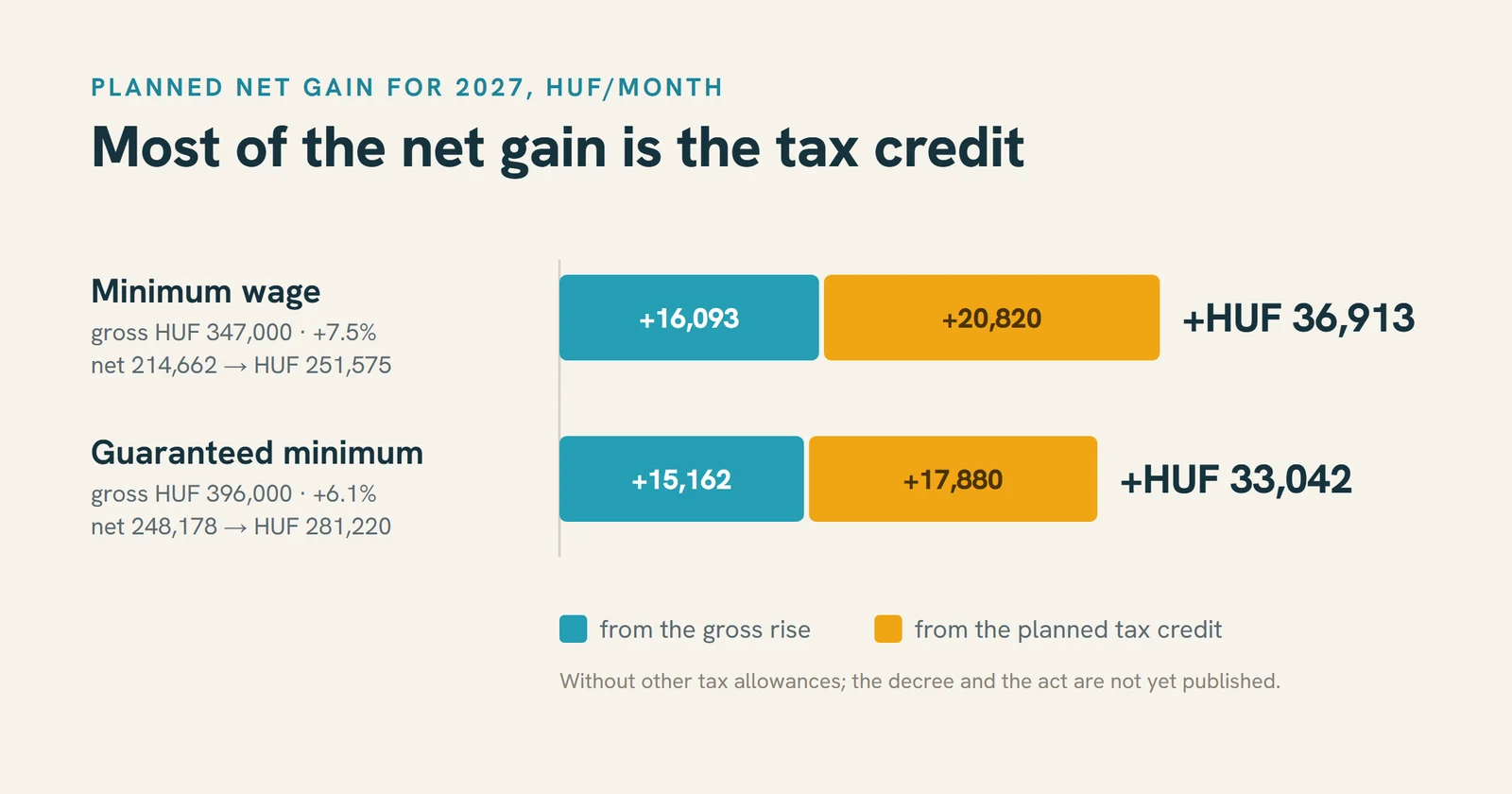
According to the government’s calculation, the net minimum wage may rise by 17.2%, nearly HUF 37,000 a month, and the net guaranteed wage minimum by 13.3%, about HUF 33,000. Most of this comes not from the gross rise but from the planned personal income tax credit, and it applies only to employees who are not entitled to other income tax allowances.
| Net, HUF/month | 2026 | 2027 without the credit | 2027 with the credit |
|---|---|---|---|
| Minimum wage | 214,662 | 230,755 | 251,575 |
| Guaranteed wage minimum | 248,178 | 263,340 | 281,220 |
The calculation assumes 18.5% social security contributions and no other allowances. The credit is HUF 20,820 a month on the minimum wage and HUF 17,880 on the guaranteed wage minimum.
How is the tax credit calculated?
Under bill T/929, submitted on 27 October 2026, and the unified text of 20 November, the tax credit reduces the tax calculated on wages:
- Up to the minimum wage it is 6% of the monthly wage, so the effective income tax is 9% instead of 15%.
- Above the minimum wage it is 6% of the minimum wage, less 6% of the wage above the minimum wage. On a gross wage of HUF 500,000 that is HUF 11,640 a month.
- At twice the minimum wage (HUF 694,000 gross a month in 2027) the credit reaches zero.
The credit applies to wages (income from employment and taxable social security benefits), first for wages accounted for the period after 31 December 2026. It does not yet apply to the December wage paid in January.
Who gains nothing from it?
The bill turns the existing allowances from tax base allowances into allowances that reduce the tax itself, and fixes the order: the tax credit reduces the tax first, and the other allowances follow.
- Under-25s and mothers exempt from income tax: their allowance already reduced the tax on their wages to zero, so the credit does not increase their net pay. A minimum wage earner under 25 will take home HUF 282,805, with the increase coming from the gross rise alone.
- Employees claiming the family allowance: they do receive the credit. Under the bill the family allowance reduces the tax by HUF 20,000, 40,000 or 66,000 a month per dependant (for one, two, and three or more dependants), and the unused part can still be claimed against contributions. The net gain falls short of HUF 37,000 where the allowance uses up both the tax and the contributions.
- People with severe disabilities: the personal allowance is 5% of the minimum wage a month (rounded to HUF 100), so it grows with the minimum wage.
What does this mean for payroll?
- The employer applies the credit every month when deducting the tax advance, without a separate request. Employees can state in their tax advance declaration how the credit should be applied. The separate written opt-out in the bill as submitted is no longer in the unified text of 20 November, which goes to the final vote.
- Several employers, bonuses during the year: over the year the credit depends on all wages, and a month counts as one eligibility month even if the employee is paid by several payers. If both employers deduct the monthly credit, the employee may have to pay tax back in the annual return. It is worth warning part-time colleagues and those with more than one job in advance.
- New lines on the certificate and in the return: the tax advance certificate must show the credit and each allowance separately, and the monthly return must include the credit applied and the eligibility months.
- The final vote is still to come: the Legislative Committee submitted the unified text on 20 November, and this article follows that text. The final rules will be set by the promulgated act.
Amounts that change with the minimum wage
The minimum wage is the reference for many rules. If the decree sets the announced amount, these values rise as well (the 2027 values are our own calculations):
| Item | Rule | 2026 | 2027 (calculated) |
|---|---|---|---|
| Monthly maximum of GYED (childcare benefit) | 70% of twice the minimum wage | HUF 451,920 | HUF 485,800 |
| Daily maximum of sick pay | one thirtieth of twice the minimum wage | HUF 21,520 | HUF 23,133 |
| Insurance threshold for engagement contracts | 30% of the minimum wage | HUF 96,840/month | HUF 104,100/month |
| Tax-exempt income of flat-rate taxpayers | half of the annual minimum wage | HUF 1,936,800/year | HUF 2,082,000/year |
| Social contribution tax relief for labour market entrants (first year of employment; half of it for the next six months) | 13% of the minimum wage | HUF 41,964/month | HUF 45,110/month |
| Minimum contribution base of sole traders and members of companies | minimum wage or guaranteed wage minimum | HUF 322,800 / 373,200 | HUF 347,000 / 396,000 |
For the daily maximum of sick pay, the minimum wage in force on the first day of entitlement counts: for an incapacity that began in 2026 and runs into January, the earlier ceiling stays.
For the social contribution tax relief for labour market entrants, the first year and the six months after it apply to employment that started on or after 1 August 2024. For earlier employment the old rule runs out: the relief lasts three years from the start of employment, in full for the first two years and at half in the third, so in 2027 it can still apply until the end of July at the latest.
Cafeteria: which limits rise?
Among fringe benefits, the limits that the law ties to the minimum wage rise. The tax-free limit for culture, sports and zoo tickets may rise to HUF 347,000 a year each, and the per-occasion limit of the low-value gift and the monthly remote work allowance to HUF 34,700. The HUF 450,000 annual SZÉP Card limit, the Active Hungarians limit (HUF 120,000) and the housing support for under-35s (HUF 1.8 million a year) are fixed amounts and do not change. The details are on the c1 cafeteria website: Minimum wage 2027: how cafeteria limits rise.
To do before January
- Find out whose pay falls below the new minimum wage or guaranteed wage minimum, and prepare the amendments to the employment contracts.
- Recalculate payroll cost with the new amounts, including the 13% social contribution tax.
- Review the lower bands of the pay scale: because of the tax credit, net differences narrow faster than gross ones.
- Agree with your payroll software provider on the January parameter update and the handling of the tax credit.
- Inform employees in advance: the December wage paid in January still follows the old rules, and the new net pay first appears when the January wage is paid.
- Follow the publication of the government decree and the adoption of the bill, and update your plan with the final figures.
For the background, see our earlier post: Pay planning for 2027: what should employers focus on now?
Sources
- The government’s statement on the agreement (20 November 2026, in Hungarian)
- Bill T/929 on introducing the tax credit (Hungarian Parliament, submitted on 27 October 2026)
- Unified text T/929/11 (Legislative Committee, 20 November 2026)
- Government Decree 426/2025 (XII. 23.) on the 2026 minimum wage (National Legislation Database)
- Act CXVII of 1995 on Personal Income Tax (National Legislation Database)
- Act LXXXIII of 1997 on the Services of Compulsory Health Insurance (GYED, sick pay)
- Act CXXII of 2019 on Entitlement to Social Security Benefits (insurance threshold, contribution base)
- Act LII of 2018 on Social Contribution Tax
- National Federation of Workers’ Councils: agreement on the 2027 minimum wage
- Adózóna: tax credit and income tax allowances from 2027
- Portfolio: the smallest rise in years (19 November 2026, in Hungarian)
- Portfolio: how far higher pay may follow the minimum wage (20 November 2026, in Hungarian)
- Portfolio: the minimum wage and the guaranteed wage minimum over the years (21 November 2026, in Hungarian)
- Hungarian Tax Authority (NAV): the social contribution tax relief for labour market entrants from 1 January 2025 (in Hungarian)
This article is for information only and is not tax or legal advice. The 2027 amounts are planned values until the government decree and the tax act are published.
More posts
Codebase among the BSE50 2026 companies
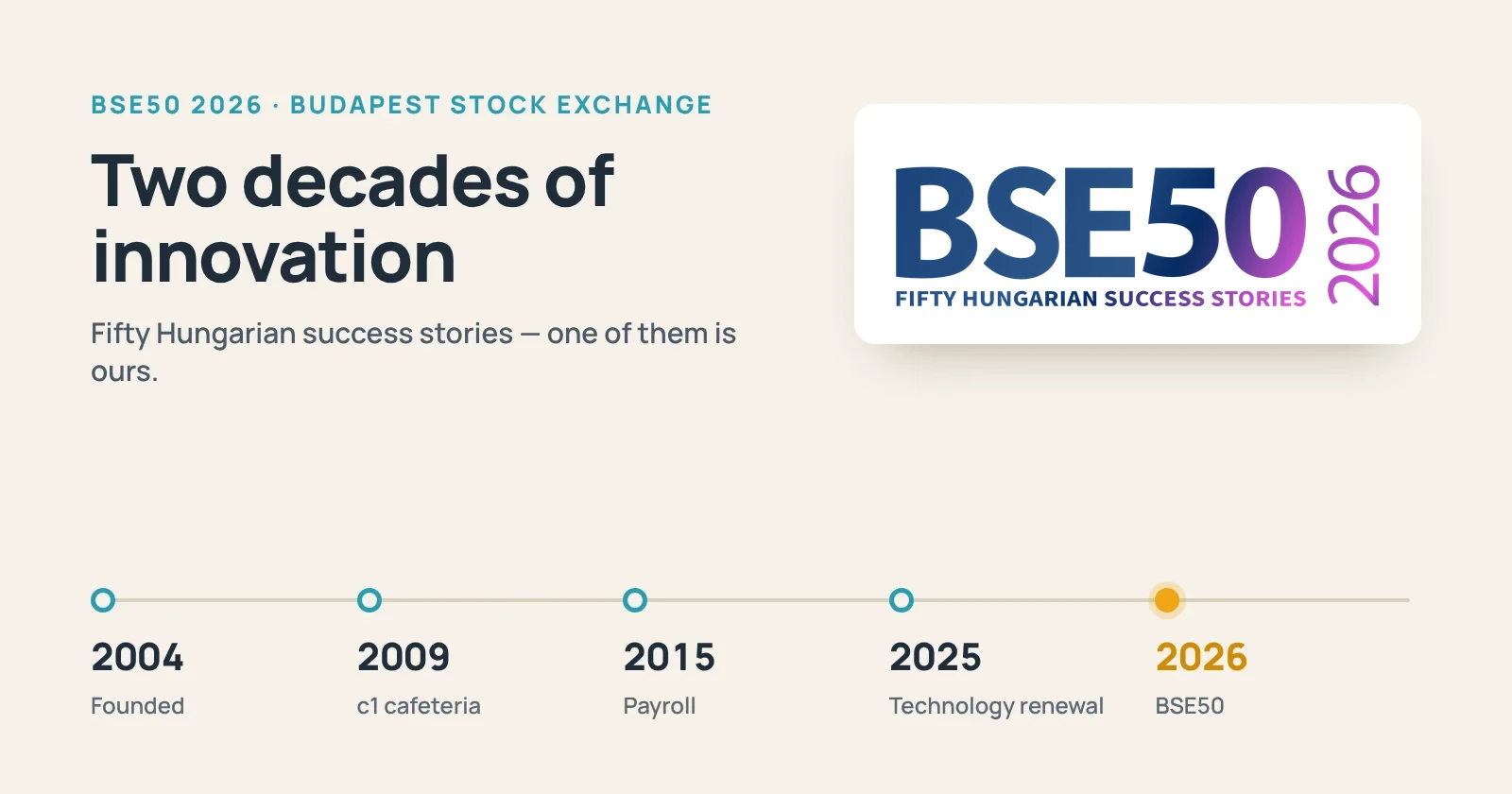
The Budapest Stock Exchange has published BSE50 2026, its book on the success stories of fifty Hungarian companies. Codebase Kft., the company behind Codebase Payroll Services, is one of them. We are very proud of this recognition from the market.
Pay planning for 2027: what should employers focus on now?
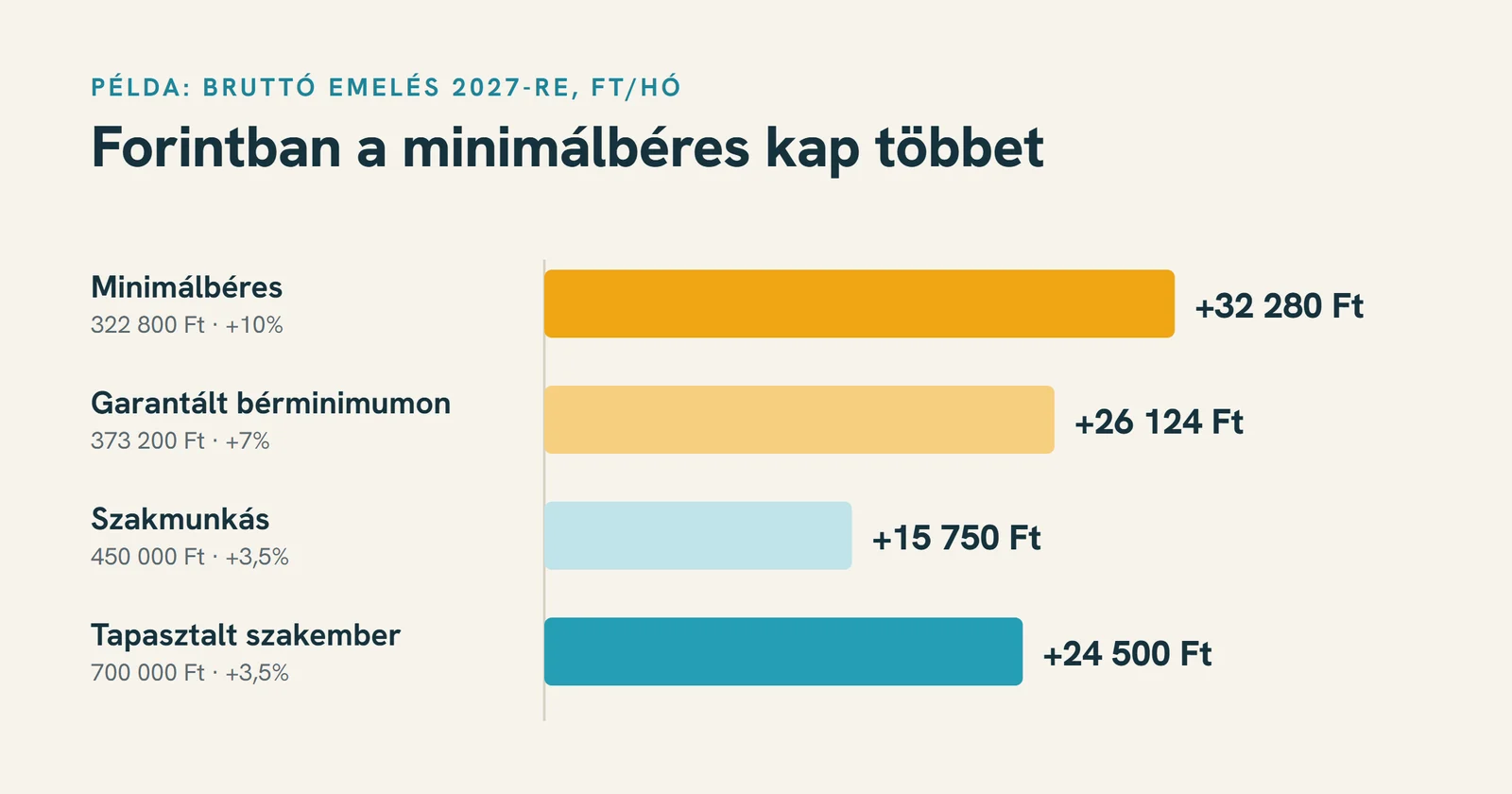
The 2027 pay rise budget has not been decided yet, but anyone who waits until December will be scrambling in January. What we know about the minimum wage and the guaranteed wage minimum, why the gap at the bottom of the pay scale is closing, what to watch in employer charges and pay transparency — and a checklist for the rest of the year.

Overtime, annual leave and sick leave: a quick guide
How much is overtime pay, and do you have to accept overtime? How many days of leave are you really entitled to, and is it lost if you do not take it? What is the difference between sick leave and sick pay? The three most misunderstood areas, explained.
Let’s talk about your payroll.
A few details about your company, and we get back to you within one working day: we learn about your current processes and prepare a tailored proposal. Or call us during office hours.