
Does the employment contract still have to be signed before starting work?

In many places the new colleague has long since started by the time the employment contract makes its way up the hierarchy to the signatory, even though it should be concluded before work begins – so says the Labour Code. Failing to do so can create an unlawful situation and lead to a fine during a labour inspection.
In addition to the employment contract, the employer must also give the employee detailed written information containing the essential terms of the employment. If this information is incomplete or not prepared in time, the Labour Code allows 7 days to supply the basic information, and in certain cases, even where the documentation is missing entirely, up to 30 days to supply it, without affecting the validity of the employment.
Did you know that, with slight exaggeration, the employment contract would fit on a handkerchief-sized piece of paper if we wrote down only what the law requires?
Under the Labour Code, the mandatory elements are merely the details of the two parties (the employer’s company data and the employee’s personal data), the employee’s base pay and job title – to be put on paper and signed by mutual agreement.

Beyond this there are quite a few details that, under the law, are taken as the default “in the absence of an agreement”:
- The employment is for an indefinite period.
- The place of work is where the duties of the job are usually performed.
- Daily working time is 8 hours.
- The employment starts on the day after the contract is signed.
The employer, on the other hand, has an extensive duty to provide information.
The Labour Code gives 7 days to inform the new employee in detail on 12 topics.
- Who exercises employer’s rights: the person exercising the employer’s powers.
- Start and duration of employment: the start date and whether it is fixed-term or indefinite.
- Place of work: where the work is performed.
- Duties of the job: the employee’s tasks.
- Daily working time: its length, the days of the week on which working time may be scheduled, the possible start and end of the scheduled daily working time, the possible extent of extraordinary working time, and the specific nature of the employer’s activity (e.g. continuous or multi-shift operation).
- Method and frequency of wage accounting and the pay day.
- Pay beyond base pay and other benefits.
- Amount of leave, its calculation and the rules for granting it.
- Rules relating to termination of employment: in particular the rules for determining the notice period.
- The employer’s training policy and the amount of time the employee may use for training.
- Name of the authority to which the employer pays the public charges relating to the employment.
- Scope of a collective agreement: whether the employer is covered by a collective agreement.
The employer’s information must be prepared in the form laid down by law, but for the following points it is sufficient to refer to the legislation below, to simplify administration:
- The details of working-time scheduling and extraordinary working time are governed by sections 99–107 of the Labour Code.
- The provisions on wage accounting and the frequency and day of payment are in sections 157–165.
- The amount of leave and the rules for granting it are set out in sections 115–133.
- The provisions on termination of employment are in sections 64–85.
If a collective agreement is in force, its content may override the statutory parts, so where one exists, the information must refer to the content of that document and where it can be viewed.
This way the information becomes more concise, and the employer can refer to the relevant statutory texts; with each change, there is no need to amend every employee’s employer information.
It is important to stress that the data recorded in the employment contract cannot be changed in the information document!
From the employer’s point of view, it is worth including as little as possible in the employment contract, or only the mandatory elements, because its content can only be changed by mutual agreement, whereas the employer’s information can be changed unilaterally (by the employer).
As an employee, it is important that the details that matter to us or are essential for us are agreed within the employment contract.
* The content published on this blog is protected by copyright and is for information purposes only. It does not constitute official legal advice or an expert opinion. The posts were prepared on the basis of the information available and our best knowledge at the time of publication. Please note that legislation may change over time, which may affect the current legal accuracy of what is written. It is therefore recommended to keep up to date with the relevant legislation in every case.
More posts

Codebase among the BSE50 2026 companies
The Budapest Stock Exchange has published BSE50 2026, its book on the success stories of fifty Hungarian companies. Codebase Kft., the company behind Codebase Payroll Services, is one of them. We are very proud of this recognition from the market.
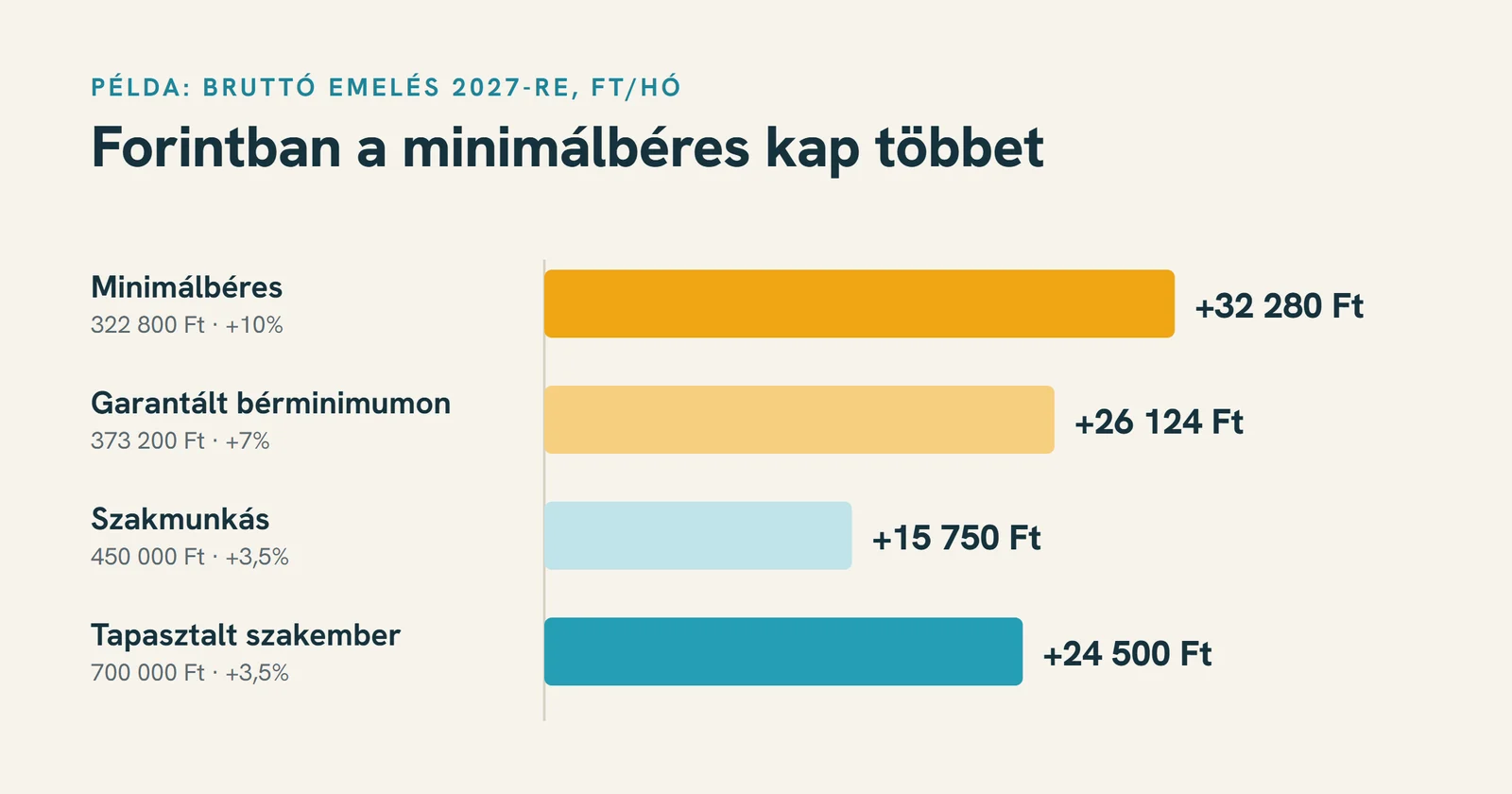
Pay planning for 2027: what should employers focus on now?
The 2027 pay rise budget has not been decided yet, but anyone who waits until December will be scrambling in January. What we know about the minimum wage and the guaranteed wage minimum, why the gap at the bottom of the pay scale is closing, what to watch in employer charges and pay transparency — and a checklist for the rest of the year.

Overtime, annual leave and sick leave: a quick guide
How much is overtime pay, and do you have to accept overtime? How many days of leave are you really entitled to, and is it lost if you do not take it? What is the difference between sick leave and sick pay? The three most misunderstood areas, explained.
Let’s talk about your payroll.
A few details about your company, and we get back to you within one working day: we learn about your current processes and prepare a tailored proposal. Or call us during office hours.